Key Takeaway
The Columbia Records pressing plant in Terre Haute, Indiana operated from the 1950s until 1982, producing millions of vinyl records that shaped the sound of multiple generations.
Records pressed at this facility can be identified by a small "T" or "CT" etched in the dead wax, marking them as pieces of both musical and manufacturing history.
The plant's legacy endures not only in its collectible pressings but also in the unchanged vinyl production process still used today during the current vinyl renaissance.
The Vinyl Pressing Process
The Art of Pressing Vinyl: Inside Columbia Records' Terre Haute Manufacturing Plant
The vinyl pressing process was extremely interesting for me.
I personally experienced vinyl pressing process at the CBS Records, Terre Haute, Indiana manufacturing plant in April 1978.
When you place a vinyl record on your turntable and hear that warm, analog sound fill the room, you're experiencing the culmination of a fascinating manufacturing process that has remained largely unchanged for decades.
At the heart of this process is the transformation of a small piece of heated vinyl—called a "biscuit"—into a full-sized LP.
To understand how this remarkable process works, let's take a journey inside one of the industry's most notable facilities: the Columbia Records pressing plant in Terre Haute, Indiana.
Setting The Stage: My Story Of Vinyl Pressing
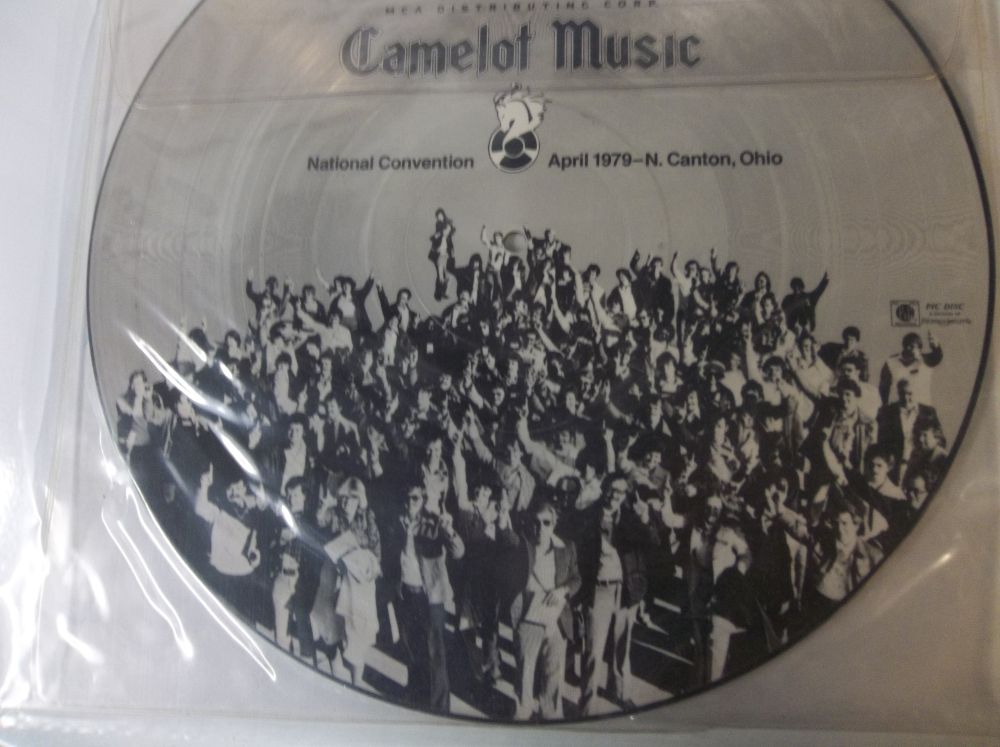
It was a Wednesday Morning after breakfast, in Canton, Ohio. The scene is my second company convention, working for Stark Record & Tape Service.
Stark, named after Stark County, Ohio, was the parent company for whom I worked. I was a store manager of a Camelot Music Record Store.
This was my second company convention, I was still experiencing some awesome new moments with my fellow store managers. Still getting to know some company home office department, leaders, and spent some time getting to meet and to know better other Camelot managers.
I belief at this time there were over 100 Camelot store managers from over 20 states representing Mall up and down the Eastern USA and some Midwest mall locations as well.
We were all together at our Camelot Store annual event.
My first convention was wonderful, but also a quick learning experience for a newbie. I didn't know anyone at the company's home office level.
Nor did I know any store managers, with the exception being Tony, whom I had pestered back in 1976 to help me meet the District supervisor. Eventually, I did mention Jeff his supervisor and Jeff Hired me for a Manager position.
At Breakfast Wednesday Morning, April 26, 1976 it was announced we were all in for a huge surprise at mid-morning.
We met ate the parking lot and by then It had leaked that we were being flown from Canton-Akron Airport to Terre Haute, Indiana.
On the plane ride we were told that CBS Records was inviting us to a tour of their Manufacturing plant in Terre Haute.
What follows is the story of Vinyl and what we experienced first hand that day.
Vinyl Pressing Process
Columbia's Midwestern Manufacturing Hub
Columbia Records operated a pressing plant in Terre Haute, Indiana, from 1953 to 1982, strategically positioned in the Midwest to efficiently serve the heart of America.
During the heyday of LPs, major labels like Columbia had pressing plants in various parts of the country—typically on the East Coast, in the Midwest, and on the West Coast—to reduce shipping costs.
The Terre Haute facility was one of several Columbia plants, alongside locations in Pitman, New Jersey, and Santa Maria, California.
Unlike small independent labels who shopped around for pressing capacity, Columbia operated its own facilities for metal parts fabrication, mastering, and pressing, using a system of lacquer copy distribution that ensured uniform quality control across several manufacturing centers.
This meant that whether your Columbia record was pressed in Indiana, New Jersey, or California, it would sound virtually identical.
We also learned that this was where all Columbia House Club products were manufactured for the entire United States.

CBS Vinyl Pressed
From Biscuit to Record: The Pressing Process
The heart of any vinyl pressing operation is the hydraulic press, and the process begins with something that might seem surprisingly simple: tiny pellets of polyvinyl chloride (PVC).
Here's how the transformation happens:
Creating the Biscuit
Vinyl records are typically made from polyvinyl chloride (PVC).
Pellets are heated to a molten state and formed into a "biscuit" or "puck"—a soft lump centered between two stampers.
Think of this biscuit as a hot, pliable disc roughly the size and shape of a hockey puck.
These pellets get loaded into a hopper on the record press and are melted and squeezed into what's often referred to as a "biscuit"—a blob of vinyl shaped like a hockey puck.
Reflections and Insights
There's something profoundly moving about holding a record pressed at the Terre Haute plant and realizing you're touching a piece of American industrial craftsmanship.
These weren't just products rolling off an assembly line—each record represented a marriage of art and precision engineering, where tons of pressure transformed raw vinyl into vessels that would carry music across decades.
The workers at Terre Haute were part of something larger than themselves.
They were the unseen hands that brought our favorite albums to life, ensuring that Miles Davis' trumpet, Bob Dylan's poetry, and countless other artists' visions reached our turntables with clarity and warmth.
Every inspection, every quality check, every careful packaging was an act of dedication to the music and to us, the listeners.
What strikes me most is how this manufacturing process—developed and perfected in plants like Terre Haute—has remained essentially unchanged.
In our age of constant technological disruption, there's something reassuring about knowing that today's vinyl records are still made the same way: heat, pressure, and precision.
It's a testament to the engineers and workers who got it right the first time.
The small "T" or "CT" etched in the dead wax isn't just a manufacturing code—it's a signature, a whisper from the past saying "we made this here, in Terre Haute, with care."
For collectors, finding that mark is like discovering a maker's signature on a fine piece of furniture.
It connects us to a specific place, a specific time, and specific people who took pride in their work.
As vinyl experiences its remarkable renaissance, we're rediscovering what the Terre Haute workers always knew: there's magic in the analog, in the physical, in the tangible connection between artist and listener.
Those records they pressed decades ago still spin, still sing, still matter. That's not just good manufacturing—that's legacy.
The Stampers: The Real Stars of the Show
Before any pressing can begin, metal stampers must be created. These are negative impressions of the original master recording, created through an electroplating process.
Each stamper can produce between 500 and 1000 records before degrading, so several stampers are made at this stage, depending on the size of the pressing run.
At the Terre Haute plant, as at all Columbia facilities, these stampers would have been manufactured locally from lacquers sent from Columbia's mastering facilities.
Columbia cut multiple lacquers from a master tape mix "simultaneously" and distributed these lacquers to their plants, which used these to manufacture metal parts locally.
Thank You for Your Support!
Thank you for being a loyal reader of America's Top Ten Albums Insights!
Your passion for music history and these weekly journeys through classic albums means the world to me.
This blog is supported through affiliate sales, and when you make purchases through links on this site, you're helping keep these stories and memories alive.
I'm grateful for your continued support and for being part of this community that celebrates the soundtrack of our lives.
Here's to many more musical discoveries together!
Cheers, George
The Pressing Moment
With labels already placed on either side, the press closes around the biscuit.
High pressure and heat force the stampers into the vinyl, molding the grooves into the disc's surface.
Pressing takes just a few seconds per record.
The numbers involved are staggering. The record press closes under a pressure of about 150 tons, while steam is pumped into the die as the biscuit is squeezed between the stampers with one-and-a-half tons of force.
Though the steam is pre-heated to 300°F, the extreme pressure generated by the press further heats the steam to around 960°F.
It's not just the pressure that creates the grooves—the intense heat melts the plastic so it flows precisely into every microscopic groove of the stamper, transferring the musical information with remarkable fidelity.
Labels and Finishing
An often-overlooked detail is how the record labels are applied.
The record's labels are baked beforehand until every drop of residual moisture is extracted from the paper—a step necessary to avoid cracks and bubbles during pressing.
Just before pressing, these labels are placed on either side of the biscuit.
During the pressing process, these labels become permanently fused to the vinyl, creating an inseparable bond.
Once pressed, the record is quickly cooled using water or air jets to solidify the shape.
Excess vinyl (called "flash") is trimmed from the edges, producing a clean, round disc ready for packaging. Each record takes about 30 seconds to make.
Identifying Terre Haute Pressings
For vinyl collectors, knowing where a record was pressed adds another layer of appreciation to their collection.
Pressings at Terre Haute commonly have a letter "T" hand etched or stamped in the run-out, and in some cases a mother code (A, B, and C have been seen).
The code "CT" or "CTH" signified Columbia's Terre Haute, IN plant.
These subtle markings in the dead wax—the unplayable area between the last groove and the label—serve as fingerprints, telling collectors and enthusiasts exactly where their records were born.
Quality Control at Scale
While the machines are pressing the vinyl, every fiftieth record or so is taken off the press, put onto a turntable, and played aloud for quality control inspectors to ensure that its sound matches that of the approved test pressings.
Any degradation in sound quality meant it was time to swap out the stamper for a fresh one.
Records that don't meet the manufacturer's high standards are recycled, ground back into pellets of PVC to be melted down and made into future records.
This commitment to quality ensured that whether you bought a Miles Davis album pressed in Terre Haute or a Bob Dylan record from Pitman, you were getting the same high-fidelity experience Columbia promised.
The Legacy of Terre Haute
Though the Terre Haute plant closed in 1982, its legacy lives on in the millions of records it produced during its nearly three-decade run.
From jazz classics to rock anthems, the plant helped define the sound of multiple generations.
The records it pressed are now collector's items, each one a small piece of manufacturing history pressed into vinyl grooves.
The process used at Terre Haute—from biscuit to finished record—remains fundamentally unchanged in modern vinyl plants.
Today's vinyl renaissance has brought renewed appreciation for this analog format, and the same basic technique of pressing heated vinyl between metal stampers continues to produce the warm, rich sound that digital formats struggle to replicate.
Next time you spin a Columbia record and notice that small "T" or "CT" etched in the dead wax, you'll know it was born in Terre Haute, Indiana—transformed from a small, hot biscuit of vinyl into a permanent vessel for music, pressed with tons of force and precision engineering that would make any manufacturer proud.
Join The Conversation
What were you listening to this week in history? Did you buy one of these albums when it was new?
Share your memories below, or join the discussion on our Music in the 1970s Facebook page to keep the needle spinning.
Follow Music In The 1970s
Love classic rock, soul, and everything 70s?
Join us for daily album insights, rare stories, and lively discussions.
Keep the golden era of music alive with fellow fans!
Visit Music In The 1970s
Facebook Music In The 1970s