Billboard's Top 200 Album Sales
Key Takeaway
The week of January 28, 1978 belonged entirely to disco fever as the Saturday Night Fever soundtrack dominated the charts with unstoppable force.,/p>
This moment captured American pop culture at a pivotal crossroads—disco balls spinning in every corner while rock icons like Queen, Fleetwood Mac, and Billy Joel held their ground.
The charts told a story of musical diversity where dance-floor anthems coexisted with stadium rock and soft pop balladry.
Teen idol Shaun Cassidy rubbed shoulders with progressive rock maestros Styx, proving that 1978's music landscape was as eclectic as it was exciting.
This was the week that showed how one soundtrack could define an entire cultural movement while classic album rock refused to fade away.
A Snapshot in Time
Before diving into the music, here's what else was happening during the week of March 28, 1981:
Walter Cronkite signed off as CBS Evening News anchor for the last time on March 6, after 19 years, while Dan Rather began his tenure as lead anchorman on March 9, marking a changing of the guard in American journalism.
On March 27, Poland's Solidarity movement staged a massive four-hour nationwide warning strike with approximately 12 million workers participating, representing one of the largest peaceful protests in Eastern European history during the Cold War era.
Tennis legend Martina Navratilova defeated 16-year-old Andrea Jaeger 6-3, 7-6 in the final of the WTA Tour Championships at Madison Square Garden on March 28.
Just two days before this chart week, on March 30, President Ronald Reagan was shot and wounded in an attempted assassination by John Hinckley Jr. outside a Washington, D.C. hotel. Press Secretary James Brady and two police officers were also wounded in the attack.
The 53rd Annual Academy Awards ceremony was held in Los Angeles, honoring films released in 1980, celebrating Hollywood's finest achievements.
The first London Marathon took place on March 29, establishing what would become one of the world's premier road racing events.
On March 26, comedian Carol Burnett won a landmark $1.6 million verdict against the National Enquirer in a libel lawsuit, setting an important precedent for celebrity legal rights and media accountability.
Just as America was experiencing these pivotal moments, these were the albums spinning on turntables and cassette players across the nation.
This Week’s Top Ten Albums in America
Featured Hits: "Keep On Loving You" (#1), "Take It on the Run" (#5)
Featured Hits: "The Best of Times" (#3), "Too Much Time on My Hands" (#9)
Featured Hits: "Tom Sawyer," "Limelight"
Featured Hits: "(Just Like) Starting Over" (#1), "Woman" (#2)
Featured Hits: "Love on the Rocks," "Hello Again," "America"
Featured Hits: "While You See a Chance," "Arc of a Diver"
Featured Hits: "Don't Stand So Close to Me," "De Do Do Do, De Da Da Da"
Featured Hits: "Hit Me With Your Best Shot," "Treat Me Right"
Featured Hits: Live versions of "Wheel in the Sky," "Any Way You Want It," "Lovin', Touchin', Squeezin'"
Featured Hits: "Woman in Love," "Guilty" (duet with Barry Gibb)
Join the newsletter for weekly chart rewinds
I send out a simple weekly newsletter every time a new article is published.
No spam.
No daily emails.
Just a quick note letting you know something new is live.
When Was the Last Time You Cleaned Your Records?



Album of the Week Spotlight
Saturday Night Fever - Soundtrack
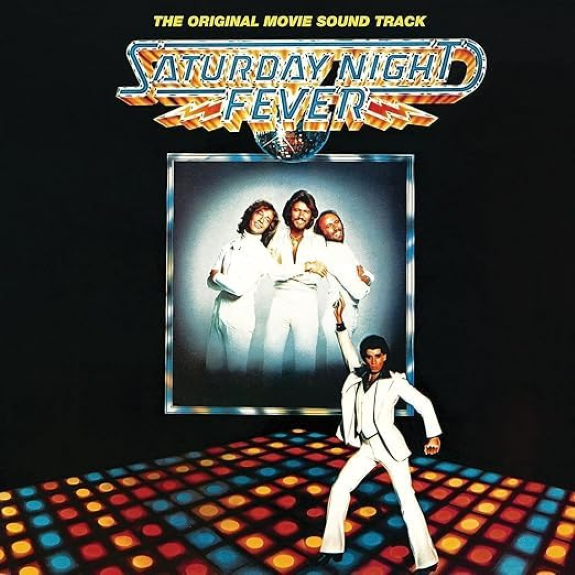
Saturday Night Fever Soundtrack
 Album of the Week Spotlight
Why I Picked It:
Moving Pictures, released February 12, 1981, became Rush's most commercially successful album, and for me, it represents the perfect intersection of artistic ambition and mass appeal.
This album spent 12 weeks in the Top 10, from March 21, 1981, to June 6, 1981, and fundamentally changed how people thought about progressive rock.
As manager of the Camelot Music store at Eastview Mall in Victor, New York, I witnessed firsthand the phenomenon this album created.
I sold it to customers mostly in cassette format—cassettes were absolutely dominating the market by 1981.
Only a handful of customers purchased 8-track tapes at this time, as that format was rapidly dying.
We were still selling vinyl albums, of course, but the cassette's portability made it the format of choice for most buyers.
What about compact discs, you ask? At this time, compact discs really weren't a thing yet.
The album was released on compact disc in 1984, three years after the original release.
I honestly don't recall ordering Rush on the compact disc format when Moving Pictures first came out—CDs wouldn't become mainstream until the mid-1980s.
Rush was extraordinarily popular in the Rochester, New York market, and geography played a crucial role in that success.
Rush is from Toronto, which, if you know your geography, lies roughly 80 miles across Lake Ontario from Rochester.
Water may separate us, but the Canadian airwaves easily carried Rush to us on FM radio from the big stations in Toronto.
Rochester's WCMF 96 FM, in particular, was on heavy rotation for Rush's music.
We didn't need to play Rush in-store—they already had a built-in, devoted fan base thanks to Toronto's proximity to Rochester.
But there were other compelling reasons this album mattered so profoundly:
Moving Pictures followed a more radio-friendly format than previous Rush albums, with tighter and shorter song structures.
"Tom Sawyer" was co-written with Canadian group's Max Webster lyricist Pye Dubois, and its opening synthesizer riff became one of the most recognizable intros in rock history.
The song peaked at #24 in Canada and #44 on the US Billboard Hot 100.
"Limelight," written about the pressures of fame, showcased Neil Peart's increasingly personal lyrical approach.
The instrumental "YYZ" was nominated for a Grammy Award for Best Rock Instrumental Performance.
The title referenced the IATA airport identification code for Toronto Pearson International Airport, and the opening rhythm spelled out Y-Y-Z in Morse code—a clever touch that delighted fans.
Critically, the album represented Rush at their absolute peak.
They recorded using 48-track recording for the first time at Le Studio in Morin-Heights, Quebec, allowing for unprecedented sonic depth.
The production was crisp, modern, and perfectly suited for FM radio while maintaining the complexity that longtime fans loved.
Culturally, Moving Pictures proved that progressive rock could achieve mainstream success without compromising artistic integrity.
It bridged the gap between the '70s prog-rock movement and the more accessible sound of the '80s, influencing countless bands that followed.
My Connection
I was the manager of the Camelot Music store at Eastview Mall, Victor, New York, when this album was released.
We did not play Rush in-store, as there was no need for that.
Rush, as I previously mentioned, already had a built-in fan base from Toronto's proximity to Rochester, NY, and our radio station, especially WCMF 96 FM, was on heavy rotation for Rush's music.
The excitement around Moving Pictures was palpable. Customers would come in asking for it by name, many of them pre-ordering before release.
The cassette format was crucial to the album's success—people wanted to play it in their cars, on their Walkmans, everywhere.
This was music meant to be lived with, not just listened to.
I remember the discussions customers would have about the album's triple-entendre cover art—movers physically moving pictures, people crying because the pictures were emotionally moving, and a film crew making a moving picture.
Rush fans appreciated those kinds of clever details.
Straight From the Music Store Days!


Reflections & Insights
This week's chart reveals a fascinating moment of transition in American music.
The dominance of arena rock bands like REO Speedwagon, Styx, and Rush showed that rock music had fully embraced stadium-sized ambitions and radio-friendly production.
Yet within that mainstream success, there was remarkable diversity—from Rush's progressive complexity to REO Speedwagon's heart-on-sleeve power ballads.
John Lennon's presence on the chart with Double Fantasy served as a poignant reminder of rock's recent past.
Released just weeks before his death, the album's climb up the charts became a collective act of mourning and celebration.
Meanwhile, newer acts like The Police represented the new wave influence that would soon transform the charts.
What's most striking is how 1981 represented the last gasp of the album-oriented rock era. MTV would launch on August 1, 1981, and within months, the music industry would never be the same.
Visual presentation would become as important as sonic achievement.
But in March 1981, albums still reigned supreme, and the Top 10 was dominated by bands who had built their success through relentless touring, FM radio airplay, and word-of-mouth—not music videos.
The Midwest rock explosion of this era—centered on bands from Chicago (Styx, REO Speedwagon), Detroit, Cleveland, and Toronto (Rush)—showed that American rock had moved beyond its coastal centers.
These were working-class bands who connected with working-class audiences, and their music reflected the hopes, frustrations, and dreams of Middle America.
 Trivia Corner
REO Speedwagon's record label initially rejected "Keep On Loving You," with lead singer Kevin Cronin having to fight to get it included on Hi Infidelity. It became the band's first #1 hit.
The first CD pressings of Moving Pictures were missing the first beat of "Tom Sawyer" by mistake, which was corrected in subsequent releases.
Paradise Theatre became Styx's fourth consecutive multi-platinum album, making them the first rock band in history to achieve such a feat.
"Woman" by John Lennon replaced his own re-released "Imagine" at #1 in the UK charts, a bittersweet achievement following his death.
The song "Tough Guys" from Hi Infidelity used an audio clip from the 1937 Our Gang short film "Hearts Are Thumps".
 Frequently Asked Questions (FAQ)
Q: Why was cassette the dominant format in 1981 instead of vinyl?
A: While vinyl remained popular for home listening, cassettes offered portability and durability.
The rise of car cassette players and the Sony Walkman (introduced in 1979) made cassettes the format of choice for music on the go. By 1981, cassette sales were rapidly catching up to vinyl.
Q: When did compact discs become available?
A: The first commercial CD players were released in October 1982 by Sony and Philips, with the first CDs released simultaneously.
However, CDs didn't become mainstream until the mid-to-late 1980s. In March 1981, CDs were still in development and not yet available to consumers.
Q: Why was Rush so popular in Rochester, NY?
A: Rochester's proximity to Toronto (about 80 miles across Lake Ontario) meant that Rochester radio stations could pick up Toronto FM stations, where Rush received heavy airplay as a local band.
This cross-border radio exposure gave Rush a built-in fan base in the Rochester market that rivaled their popularity in Canada.
Q: What made Moving Pictures different from earlier Rush albums?
A: Moving Pictures featured more concise, radio-friendly songs compared to Rush's earlier work, which often featured lengthy compositions and extended instrumental sections.
While still musically complex, songs like "Tom Sawyer" and "Limelight" had more accessible structures that appealed to mainstream audiences while maintaining the band's artistic integrity.
Join The Conversation
What were you listening to this week in history? Did you buy one of these albums when it was new?
Share your memories below, or join the discussion on our Music in the 1970s Facebook page to keep the needle spinning.
Follow Music In The 1970s
Love classic rock, soul, and everything 70s?
Join us for daily album insights, rare stories, and lively discussions.
Keep the golden era of music alive with fellow fans!
Visit Music In The 1970s
Music in the 1970s